What the Anion Gap Measures
The anion gap is a useful way to evaluate serum chemistries and seek clues about acid-base balance. It contrasts the major measured electrolytes in a blood sample to estimate whether there are important unmeasured anions present. An anion gap calculator helps turn common laboratory values into a useful diagnostic indicator that can support clinical reasoning.
In routine practice, the anion gap is most often used as part of a broader review of the electrolyte panel or serum chemistry panel. It does not stand alone as a diagnosis. Instead, it helps clinicians interpret an abnormal result and decide whether the pattern suggests an acid-base disorder, an electrolyte imbalance, or another metabolic derangement.
The basic idea is easy to understand: the body must maintain electrical neutrality, so measured positive ions should roughly balance measured negative ions. Because not every charged particle is directly measured in standard serum electrolytes, the calculated difference offers an anion difference that can signal hidden acids or other substances. This makes the anion gap a important screening tool in the setting of unexplained acidosis.
Clinically, the value matters because shifts in the anion gap can point toward a likely underlying cause of symptoms such as confusion, shortness of breath, vomiting, or dehydration. The physiologic significance of the number depends on the clinical context, not just whether it is slightly above or below the lab’s printed range.
How to Calculate the Anion Gap
The standard calculation uses sodium, chloride, and bicarbonate from the serum chemistry panel. The usual formula is:
Anion gap = sodium − (chloride + bicarbonate)
Some facilities also include potassium in a adjusted version, but the most common clinical approach relies on sodium, chloride, and bicarbonate alone. Because different analyzers and lab methods may report slightly different laboratory values, the exact reference range can vary from one institution to another.
To use an anion gap calculator, enter the measured sodium, chloride, and bicarbonate values from the same sample. The calculator then gives the estimated gap, which you can evaluate against the local normal range. A result that falls outside that range may reflect true pathology, but it may also reflect method-specific differences or a transient change in the patient’s state.
The result should always be reviewed alongside the full electrolyte panel. For example, a low bicarbonate level with a normal or elevated anion gap suggests different mechanisms than a low bicarbonate with a clearly high gap. That distinction helps differentiate one acid-base disorder from another.
Because this calculation is based on routinely measured serum chemistries, it is fast and accessible. Still, the output is only as useful as the data entered and the interpretive framework applied afterward.
Adjusting the Anion Gap for Albumin
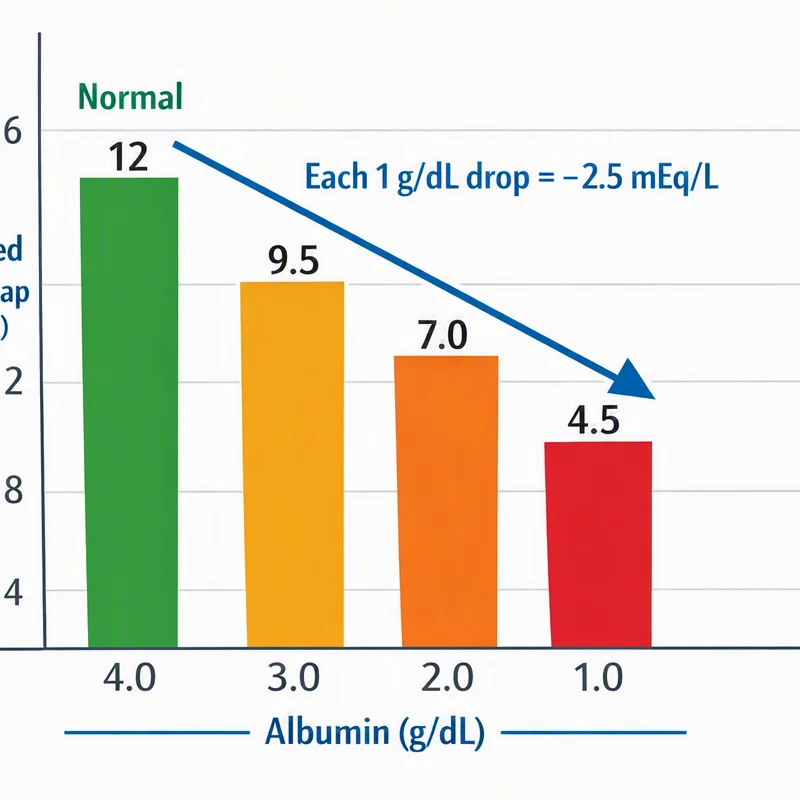
Albumin is a major indirectly measured anion in plasma, so shifts in albumin concentration can significantly influence the anion gap. When albumin is low, the measured anion gap may appear falsely normal or only mildly elevated. That is why albumin correction is an important part of interpretation.
Hypoalbuminemia lowers the contribution of albumin to the total negative charge in plasma. As a result, a patient can have clinically important acid accumulation while the unadjusted anion gap looks less obvious than expected. The corrected anion gap can expose that hidden abnormality.
Several adjustment methods exist, but the underlying goal is the same: account for the effect of low albumin so the gap better represents the true acid burden. In practice, if albumin is reduced, the corrected value may shift a patient from a seemingly normal anion gap to a truly elevated one, changing the direction of the workup.
This step is especially important in hospitalized or critically ill patients, where albumin often falls because of inflammation, fluid shifts, or nutritional issues. In these settings, albumin adjustment can enhance the accuracy of laboratory interpretation and prevent missed diagnoses.
Think of albumin correction as a refinement rather than a replacement. The uncorrected value still matters, but the albumin-adjusted result gives a clearer estimate of the patient’s real acid-base state when hypoalbuminemia is present.
Typical Anion Gap vs High Anion Gap
A normal anion gap usually shows that the proportion among measured ions is kept intact, even if bicarbonate is low. This result is often seen in hyperchloremic metabolic acidosis, also called hyperchloremic metabolic acidosis. In this situation, bicarbonate is reduced, and chloride goes up to support electrical neutrality.
A elevated anion gap suggests that surplus acids or other undetected anions have built up. This is the typical pattern in many forms of acid-base disturbance. The gap is high because bicarbonate is depleted buffering excess acid, while the newly generated anions remain in the blood and widen the difference.
Understanding this distinction is essential for acid-base status assessment. A normal-gap pattern points one way, while a high-gap pattern suggests another. The numbers help differentiate among acid-base conditions and guide the next step in the diagnostic evaluation.
It is also important to remember that a normal gap does not automatically mean there is no acid problem. The gap may be normal because the condition truly is a non-gap acidosis, or because low albumin is masking an elevated gap. That is why the result must be interpreted in the full broader clinical setting.
In practice, the anion gap is best used as a branching point. If the gap is elevated, look for causes of excess acid or unmeasured anions. If it is normal, consider bicarbonate loss, renal tubular processes, or dilutional effects depending on the overall picture.
Common Causes of an Altered Anion Gap
A number of conditions are commonly associated with a raised anion gap. One major cause is lactic acidosis, in which lactate builds up when tissues are underperfused or oxygen delivery is impaired. This can happen in shock, severe infection, or other stress states.
Ketoacidosis is a further major cause. In diabetic ketoacidosis, alcoholic ketoacidosis, or starvation states, ketone bodies build up and increase the gap. In these settings, the anion gap calculator may reveal a potentially dangerous metabolic change that may require urgent treatment.
Renal failure can also lead to a high gap because the kidneys cannot effectively excrete acid or clear retained organic acids. As kidney function worsens, unmeasured anions increase and bicarbonate drops. This pattern may evolve gradually, so serial assessment can be useful.
Toxic alcohol ingestion is a critical diagnosis not to miss. Substances such as methanol and ethylene glycol can generate toxic acids that raise the anion gap and cause severe metabolic acidosis. The laboratory pattern may be one of the earliest clues prompting urgent evaluation and treatment.
Other causes may include salicylates, certain drugs, and severe tissue breakdown, but the four entities above are among the most clinically important. In every case, the lab pattern should be matched to the patient’s symptoms, medication history, and possible exposures.
For a normal anion gap abnormality, the most common mechanism is often gastrointestinal or renal bicarbonate loss. That is why the result should not be treated as a final answer; it is a prompt to look for the underlying cause of the disturbance.
Applying the Calculator in Clinical Interpretation
The value of an anion gap calculator is greatest when it is used as part of a full clinical assessment. Start with the serum chemistry panel, calculate the gap, and then ask what the result signifies for the patient in front of you. The number can aid structure thinking, but Continue reading it should not supersede judgment.
A practical approach is to first make sure that the sample includes accurate serum chemistries, then examine the electrolyte panel for related abnormalities. Reduced bicarbonate, abnormal sodium, or marked chloride shifts can all shape the interpretation. From there, evaluate whether the pattern suggests a high-gap or non-gap process.
If the gap is increased, the next step is to think about likely sources of acid accumulation or retained acid anions. If it is normal, consider gastrointestinal losses, renal causes, or mixed disorders. In both cases, the result is a clue that directs the diagnostic workup, not the endpoint of the evaluation.
The calculator can also help detect mixed acid-base states. For example, a patient may have metabolic acidosis along with another disorder that partially blunts the expected change in bicarbonate or chloride. In that setting, the anion gap may expose a hidden process that is not obvious from a quick look at the numbers.
Used well, the calculator enhances laboratory interpretation by integrating data, physiology, and bedside context. It becomes a bridge between a raw set of laboratory values and a more reliable understanding of the patient’s condition.
Limitations and Caveats
Even a well-designed calculator has restrictions. Lab error can distort the result if a specimen is incorrectly labeled, contaminated, held up, or improperly processed. A single abnormal value should always be checked for alignment with the rest of the laboratory panel and with the patient’s condition.
Measurement variation also matters. Separate laboratories may use different instruments, calibration methods, or reporting conventions, which can shift the expected reference range. A value that is near the cutoff at one institution may be clearly abnormal at another. This is one reason the local lab’s range should always be reviewed.
Another major issue is the presence of unmeasured anions. The anion gap is only an indirect measure, so it can miss clinically relevant acids when albumin is low or when a mixed disorder is present. The number may look reassuring even though the patient has significant disease.
That is why a normal result should not end the conversation if symptoms and other findings suggest a problem. Likewise, a mildly elevated gap should not be overinterpreted without confirming the broader pattern. Context, repeat testing, and correlation with the clinical picture all strengthen reliability.
Finally, remember that the reference range is not the same everywhere. It reflects the methods used by a given lab and should be interpreted as a benchmark rather than an absolute rule. The best use of the anion gap is as one component of thoughtful laboratory interpretation.
Frequently Asked Questions
What does an anion gap calculator do?
An anion gap calculator is used to calculate the anion gap from serum chemistries such as sodium, chloride, and bicarbonate. It helps clinicians evaluate acid-base balance, identify metabolic acidosis, and interpret whether an abnormal result may reflect unmeasured anions or another disorder.
What is a normal anion gap range in serum chemistries?
The normal range depends on the lab and the instrument used, so the preferred value to use is the local reference interval. In general, a normal result suggests preserved balance among measured electrolytes, but interpretation should still also review the rest of the serum chemistries and the patient’s general clinical picture.
How do you correct the anion gap for low albumin?
To adjust for albumin, clinicians use an albumin correction to derive the albumin-corrected anion gap. This matters because hypoalbuminemia can lower the measured gap and mask a true elevation. The goal is to account for the reduced contribution of albumin so the result better reflects the real acid burden.
What causes a high anion gap metabolic acidosis?
Common causes of high anion gap acidotic state include lactate accumulation, ketotic acidosis, renal failure, and ingestion of toxic alcohols. These conditions increase acids or unmeasured anions in the blood, which expands the gap and signals a clinically important acid-base problem.
Can a normal anion gap still occur with serious illness?
Yes. A anion gap in the normal range does not eliminate serious disease. Some patients have non-gap metabolic acidosis, while others may have a hidden high-gap process masked by low albumin or mixed disorders. The result should always be interpreted in clinical context and alongside the rest of the electrolyte profile.