What’s the anion gap?
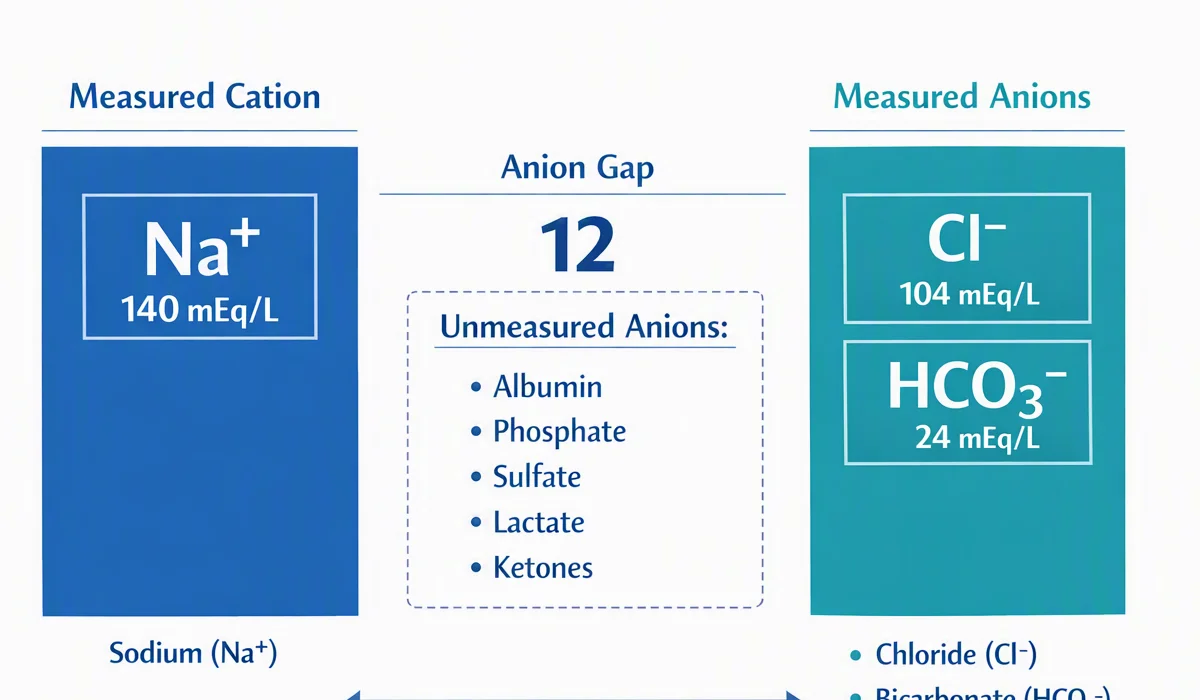
The anion gap is a calculated value used to assist in interpreting electrolytes on a blood test. It contrasts the primary positively charged and negatively charged particles in the blood, especially sodium, chloride, and bicarbonate. Because some ions are not directly measured, the anion gap provides a snapshot of the body’s charge balance and can help detect an electrolyte imbalance or a concealed process.
Clinicians often use the anion gap as a diagnostic clue during blood test interpretation. A high result can suggest specific acid disorders, while a low anion gap is less common and often suggests either a lab issue or a shift in protein levels, especially albumin. Because the number depends on the measured serum electrolytes, it should always be considered alongside other findings rather than in isolation.
How does an Anion Gap Calculator function?
The Anion Gap Calculator uses a basic calculation formula low AG lab artifact reasons derived from values from a serum chemistry panel. Typically, it subtracts chloride and bicarbonate from sodium. Certain calculators also use potassium, but many routine methods do not. The result is then checked against the lab’s reference range to see whether it falls inside a typical normal range.
This tool is helpful because it turns raw lab values into a meaningful number, but it does not explain the whole story. A result can be affected by measurement differences, albumin changes, or unmeasured ions. This is why an Anion Gap Calculator is best used as part of broader blood test interpretation, not as a stand-alone answer.
If the result seems unusual, the next step is often to review the full serum chemistry panel, check for an abnormal result, and consider whether a repeat lab test is needed. This approach helps distinguish true physiology from measurement artifact or another transient issue.
What counts as a low anion gap?
A low anion gap suggests the calculated number is under the lab’s expected normal range. Since different laboratories use slightly different methods and instruments, the reference range can change. That is why one report may look low at one facility but still be acceptable elsewhere. Lab variation matters, and a single number should not be taken at face value.
Another key factor is albumin, the main negatively charged protein in the blood. Because albumin contributes anion gap clinical significance substantially to the anion gap, low albumin can decrease the result even when everything else is stable. This is why clinicians often think about albumin correction when reviewing an unexpectedly low value.
In practice, a low result can be a benign finding, an indication of a hidden metabolic disorder, or the result of a testing problem. Understanding which possibility is most likely depends on the rest of the lab values and the person’s symptoms.
What explains a decreased anion gap?
Common reasons for a low anion gap are hypoalbuminemia, lab error, and specific disorders with excess proteins or unusual ions. In many cases, the result is not harmful alone, but it can provide an important diagnostic value clue that leads to the main cause.
A helpful approach to view the result is to consider whether the low number indicates a reduced number of unmeasured negative charges, extra measured positives, or a measurement artifact. This approach assists connect the anion gap to real physiology and to errors in the testing process.
Low albumin and altered protein levels
Albumin is part of the body’s major negatively charged proteins, so it plays a large role in the anion gap. When albumin decreases, the blood sheds some of its normal negative charge, and the calculated gap can decrease. This is the classic pattern seen in hypoalbuminemia.
Multiple conditions can reduce albumin, including hepatic disease and undernutrition. In such cases, the low result may not mean there is a serious acid problem. Rather, it may indicate altered protein concentrations that influence the calculation. Since albumin is so important, clinicians often ask whether the number should be interpreted with albumin correction.
Protein-related changes can also play a role for another reason: certain disorders increase abnormal proteins that shift the balance of measured and unmeasured ions. That can push the anion gap downward and may be an early diagnostic clue to a plasma cell disorder.
Lab or assay issues
Not each decreased value reflects a real body abnormality. Testing error can be a frequent cause for an unusually low result, especially if the number does not fit the clinical picture. A specimen error can occur during drawing, delivery, or handling, and an machine error can affect how the device interprets the sample.
One specific problem is chloride overestimation. If the analyzer reports chloride too high, the calculation used by the Anion Gap Calculator can produce a spuriously low number. This is a typical measurement artifact that might resolve on a repeat lab test.
Given these possibilities, a questionable result often warrants repeat testing. When the second sample is normal, the first result was likely due to a testing issue rather than a true electrolyte imbalance. That is one reason, low values are approached carefully before any major conclusions are drawn.
Medical conditions linked to a low anion gap
Some medical conditions can reduce the anion gap by introducing extra positively charged substances or abnormal proteins. A key example is multiple myeloma, a cancer of plasma cells that can cause paraproteinemia. With paraproteinemia, abnormal proteins may shift the charge balance and produce a low value that serves as an early clue.
Lithium toxicity is another recognized cause. Lithium is an unmeasured cation, so excess lithium can reduce the calculated gap by increasing unmeasured ions on the positive side. This is a clear example of how the anion gap can reflect more than just sodium, chloride, and bicarbonate.
Other possible causes are hypermagnesemia and hypercalcemia. Magnesium and calcium are both unmeasured cations in the standard calculation, and if they are elevated enough, they can push the result lower. These findings are less common than low albumin or lab issues, but they are important because they may point to a broader metabolic disorder or toxin exposure.
When ought a low anion gap be checked by a clinician?
A decreased reading should be reviewed by a clinician when it is repeated, unexpected, or accompanied by symptoms. Symptoms may include low strength, confusion, fluid retention, dryness, or signs of an electrolyte problem. The result also warrants attention if there is known kidney disease, because kidney problems can disrupt electrolyte handling and acid balance.
A further reason to seek review is concern for an acid-base disorder. Even though a low anion gap is not the same as acidosis, it can still suggest a incorrect calculation or an underlying issue that needs a closer look. A clinician may decide to order follow-up testing, review the full serum chemistry panel, or check for associated protein abnormalities.
If the result is only slightly low and the person feels well, the next step may simply be verifying the number and comparing it with prior lab values. If it is markedly low or new, a more complete medical evaluation is reasonable.
How to interpret findings with related lab numbers
The anion gap is most accurately read in combination with other values from the same blood test. Sodium, chloride, and bicarbonate are the main components of the calculation, but the broader pattern can show much more. For example, a low gap with high chloride may suggest a measurement issue, while a low gap with low albumin may suggest hypoalbuminemia.
Other values also matter. Potassium is not always included in the calculation, but if it is abnormal, it can suggest a wider electrolyte imbalance. Total protein and globulin are especially useful when evaluating a low result because they can show excess or abnormal proteins. Elevated globulin may raise the possibility of paraproteinemia or another protein-related condition.
Looking at the full pattern helps distinguish a routine variation from a meaningful clinical significance. For example, low albumin with low total protein may indicate nutritional or liver-related causes, while high total protein and high globulin may suggest a plasma cell disorder. This is why a single abnormal result is only a portion of the interpretation.
Practical interpretation works best when the anion gap is viewed as part of the whole panel: sodium, chloride, bicarbonate, albumin, total protein, and globulin together provide the clearest picture.
Frequently asked questions about low anion gap
FAQ sections help because since low values often prompt the same questions. Here are common questions about the anion gap calculator, what counts as a normal anion gap, and when a result warrants a closer look.
What qualifies as a low anion gap?
A low anion gap is any result under the lab’s stated reference range. As ranges differ by technique and analyzer, the same number may be considered low in one lab and within the normal range in another. This is why, the report’s own range matters more than a generic cutoff. If the result seems surprising, it is often worth confirming it with a repeat lab test.
Can a low anion gap be caused by lab error?
Absolutely. Laboratory error is one of the most common explanations. A specimen error, instrument error, or chloride overestimation can all create a falsely low result. If the number does not match the person’s condition, repeat testing is often the simplest way to check whether the value is real or just a measurement artifact.
How does low albumin affect the anion gap?
Low albumin lowers the amount of negative charge in the blood, which can reduce the anion gap. This is why hypoalbuminemia is such a common cause of a low result. Conditions such as liver disease and malnutrition may lower albumin and therefore lower the gap. In some cases, clinicians use albumin correction to better estimate the true meaning of the number.
Which serious conditions can lead to a low anion gap?
Serious causes include multiple myeloma with paraproteinemia, lithium toxicity, hypermagnesemia, and hypercalcemia. These conditions are less common than lab issues or low albumin, but they can be important underlying cause diagnoses. A clinician may look at the rest of the serum chemistry panel, the total protein, and globulin to decide whether more testing is needed.
Do I need to worry if my anion gap is low but I feel fine?
Not always. A one-time low value without symptoms may simply reflect normal lab variation, a low albumin level, or a temporary testing issue. Still, a persistently low result should not be ignored, especially if there is kidney disease, a potential acid-base disorder, or other unusual lab values. A clinician can decide whether observation, follow-up testing, or a full medical evaluation is appropriate.